Mexican Authorities Discover and Dismantle Cannabis Plantations

Regulations by 2FIRSTS.ai
Jan.17.2024
Mexican Authorities Discover and Dismantle Cannabis Plantations
Mexican authorities successfully discovered and eradicated approximately 21,900 suspected marijuana plants in five farms in Mexico's Tultitlán city.

Mexican media outlet Capital Mexico reported on January 16th that yesterday, January 15th, the Mexican security forces in Atlanta successfully discovered and dismantled approximately 21,900 suspected marijuana plants in five farms located in the town of Tulicato, in the state of Michoacan. The operation covered the areas of Kelly and "Los Maldonados.


Federal personnel on a security and crime prevention patrol mission came across these plants for the first time, which exhibited typical characteristics of marijuana. They swiftly deployed security measures and proceeded to bust three farms, spanning 375 square meters, 682 square meters, and 924 square meters respectively, with plant heights ranging from 0.6 meters to 1.4 meters.


In a continued search operation, federal officials have discovered two more farms in the same city district of "Las Nueces." These farms cover an area of 630 square meters and 1710 square meters respectively, with the marijuana plants reaching a maximum height of 45 centimeters.


After the discovery of a marijuana cultivation area, samples of the plants were collected by personnel on site and handed over to the federal prosecutor's office for analysis. Currently, the agency responsible for this investigation is conducting a thorough inquiry. This operation is part of Mexican authorities' efforts to combat illegal marijuana cultivation activities.


We welcome news tips, article submissions, interview requests, or comments on this piece.

Please contact us at info@2firsts.com, or reach out to Alan Zhao, CEO of 2Firsts, on LinkedIn


Notice

1.  This article is intended solely for professional research purposes related to industry, technology, and policy. Any references to brands or products are made purely for objective description and do not constitute any form of endorsement, recommendation, or promotion by 2Firsts.

2.  The use of nicotine-containing products — including, but not limited to, cigarettes, e-cigarettes, nicotine pouchand heated tobacco products — carries significant health risks. Users are responsible for complying with all applicable laws and regulations in their respective jurisdictions.

3.  This article is not intended to serve as the basis for any investment decisions or financial advice. 2Firsts assumes no direct or indirect liability for any inaccuracies or errors in the content.

4.  Access to this article is strictly prohibited for individuals below the legal age in their jurisdiction.


Copyright


This article is either an original work created by 2Firsts or a reproduction from third-party sources with proper attribution. All copyrights and usage rights belong to 2Firsts or the original content provider. Unauthorized reproduction, distribution, or any other form of unauthorized use by any individual or organization is strictly prohibited. Violators will be held legally accountable.

For copyright-related inquiries, please contact: info@2firsts.com


AI Assistance Disclaimer


This article may have been enhanced using AI tools to improve translation and editorial efficiency. However, due to technical limitations, inaccuracies may occur. Readers are encouraged to refer to the cited sources for the most accurate information.

We welcome any corrections or feedback. Please contact us at: info@2firsts.com

Reynolds Seeks to Join Altria Lawsuit Challenging FDA PMTA Rule and Calculation of 180-Day Deadline
Three R.J. Reynolds companies are seeking to intervene in a lawsuit filed by Altria subsidiaries Helix Innovations and NJOY challenging the FDA's 2021 PMTA final rule. The companies dispute how the agency uses Acceptance and Filing reviews and completeness determinations to establish when the Tobacco Control Act's 180-day decision period begins. Reynolds has also linked prolonged PMTA reviews to competition from unauthorized vaping products. The FDA, meanwhile, has been accelerating reviews and reducing its backlog.
Sep.14
2Firsts Data | China’s Vape-Related Exports Rise 16.5% in July 2026 as U.S.-Bound Shipments Jump 53.5%
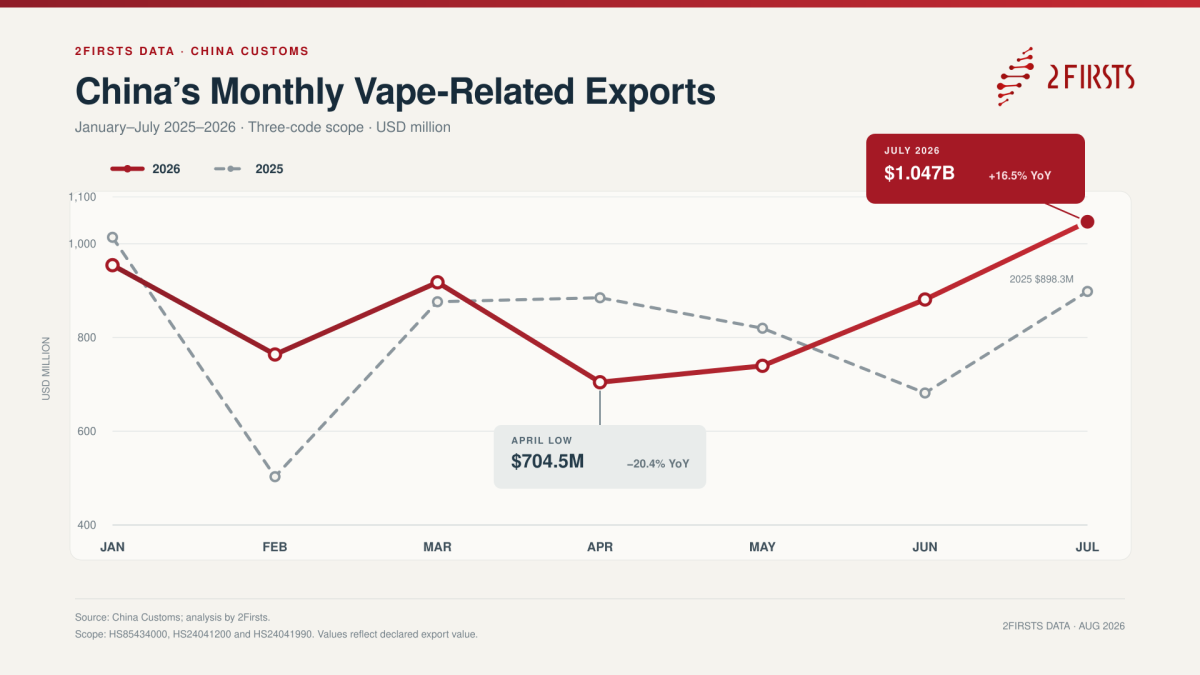
China’s vape-related exports reached $1.047 billion in July 2026, up 16.5% year on year and the highest monthly total of the year. Growth was heavily concentrated in the U.S., where exports jumped 53.5% to $404 million and accounted for 94.9% of the overall increase. Exports to all other markets rose just 1.2%. By category, nicotine-containing non-combustible products—primarily vapes—under HS24041200 rose 24.7% and generated 95.5% of the total increase. Vape-device exports under HS85434000 fell 0.4%, while other nicotine-substitute products under HS24041990 grew 88.9% but remained comparatively small.
DATA
Aug.24
South Korea Fully Reviews Nicotine-Analog and Nicotine-Free Vape Liquid Imports, With Over 99% From China and Chinese Supply-Chain Documents Under Scrutiny
Korea Customs Service has tightened import controls on nicotine-analog and nicotine-free e-cigarette liquids, placing the products under 100% document review and subjecting all e-cigarette liquid import declarations to pre-clearance ingredient analysis. As of September 20, 2026, South Korea had imported about 15 metric tons of nicotine-analog liquids, 99.99% from China, and about 316 metric tons of nicotine-free liquids, including roughly 315 metric tons, or 99.7%, from China. The measures follow South Korea's April expansion of its tobacco definition to include synthetic nicotine products and include new checks on Chinese manufacturing, transaction and export documentation.
Sep.24
Iowa Enforces Vape Registry Law as Retailers Warn Product Limits Could Increase Store Pressure
Iowa has begun enforcing its vape registry law, requiring vape products to be registered before they can be legally sold in the state. The move follows a decision by the U.S. Court of Appeals for the Eighth Circuit to lift an injunction that had blocked enforcement. Retailers have warned that tighter product availability rules could increase pressure on vape shops. One Iowa retailer said that if only a limited number of products remain available, many stores could face significant business challenges.
Aug.06
Product | DOJO Launches 0+6ml BLAST7K Fresh in UK in September, Retaining 2+8ml Pod Compatibility Ahead of October Per-Milliliter Vaping Duty
DOJO officially launched the BLAST7K Fresh on September 17, 2026, introducing a UK-market prefilled pod product with 6ml of e-liquid and a manufacturer-rated capacity of up to 7,000 puffs. The device features a 1000mAh rechargeable battery, the INSTA-JUICED structure and COREX BLAST dual-mesh technology, while retaining compatibility with existing BLAST pods. The launch comes less than two weeks before the UK's Vaping Products Duty takes effect on October 1. At the new duty rate, 6ml of vaping liquid would correspond to £1.32 in VPD. DOJO has not stated that the product's 6ml format was designed in response to the new duty.
Sep.20
Retail Case Study | Wisconsin Vape Market One Year After New Regulations: Johnny Vapes Reports 80% Sales Decline as Consumers Shift Online and Across State Lines
According to WNCY on August 24, 2026, some independent vape retailers in Wisconsin say they have faced significant business pressure one year after new vape regulations took effect. Johnny Vapes, a retailer operating in northeast Wisconsin, said its store count fell from seven locations to four, sales declined by about 80%, and roughly 90% of its inventory was affected. Retailers said some consumers have shifted to online purchases or traveled to neighboring Michigan to buy vape products. The case highlights how local regulations can reshape retail operations, inventory management and consumer purchasing patterns.
Aug.28