Reynolds Tobacco Company Wins U.S. Supreme Court Support to Challenge FDA Ruling Locally

Jun.23.2025
Reynolds Tobacco Company Wins U.S. Supreme Court Support to Challenge FDA Ruling Locally
On June 20, the U.S. Supreme Court ruled 7-2 in favor of e-cigarette companies, making it easier for them to sue over FDA decisions blocking product market entry. The case, filed by RJ Reynolds, challenges FDA’s denial of the Vuse Alto e-cigarette. The ruling could shift the balance between the industry and regulators.

Key Points:


·Court ruling: In a 7-2 decision, the Supreme Court supports e-cigarette companies, loosening litigation restrictions and allowing more businesses to challenge FDA bans. 


·Case background: Reynolds e-cigarette company (RJ Reynolds) filed a lawsuit against the FDA for refusing to authorize its Vuse Alto e-cigarette. 


·The company partnered with retailers in Texas, a conservative majority state, to file the lawsuit in the Fifth Circuit Court of Appeals. 


·Legal impact: Retailers and distributors affected by FDA decisions can now file lawsuits in local courts, not just manufacturers. 


·This may increase e-cigarette companies' chances of choosing favorable courts. 


·Judicial division: Majority opinion (Justice Barrett): Believes the law allows affected businesses (like retailers) to file lawsuits. 


·Dissenting opinion (Justices Jackson and Sotomayor): Warns that the ruling could undermine regulatory consistency and promote evasion behavior. 


·Industry and regulatory conflict: FDA has recently strengthened control over flavored e-cigarettes, but the industry continues to push back through legal means. 


·This ruling may weaken FDA's regulatory efforts and impact the future landscape of the e-cigarette market.


·The ruling marks a key victory for the e-cigarette industry in its fight against federal regulations, potentially leading to more similar lawsuits and further affecting e-cigarette policies in the US.


According to a report from the Associated Press on June 20th, the Supreme Court of the United States voted 7-2 in favor of Reynolds Vapor Co., a subsidiary of Reynolds Tobacco, allowing them to challenge the FDA's decision to refuse their e-cigarette marketing application in the Fifth Circuit Court of Appeals.


At the time of this ruling, major e-cigarette companies are opposing the federal government's years-long crackdown on e-cigarettes. It is expected that the ruling will give e-cigarette companies more autonomy to decide which judges will preside over lawsuits against e-cigarette entities.


In a ruling in April, judges reversed their stance on e-cigarettes, supporting the FDA's decision to maintain a comprehensive ban on most flavored e-cigarettes following a surge in youth vaping.


The current case is brought by the Reynolds e-cigarette company, which had already sold a range of popular berry and mint-flavored e-cigarette products before the FDA began regulating the market in accordance with the Tobacco Control Act in 2016.


The FDA has rejected approval of the company's Vuse Alto product. Supreme Court Justice Amy Coney Barrett wrote in the majority opinion that this decision "rings the death knell for a significant portion of the e-cigarette market.


The company is headquartered in North Carolina, where it is typically only able to challenge the FDA in local courts or in the FDA's headquarters in Washington D.C. However, the company has teamed up with a Texas-based business that sells its products to file a lawsuit locally. The conservative U.S. Fifth Circuit Court of Appeals has allowed the lawsuit to proceed, ruling that any business that suffers harm to its operations due to an FDA decision can file a lawsuit.


The FDA has filed an appeal to the Supreme Court, alleging that the e-cigarette company Reynolds is attempting to find a favorable court for its arguments.


However, judges found that the law does allow other businesses, such as e-cigarette retailers, affected by FDA decisions to file lawsuits in their state.


Supreme Court Justices Ketanji Brown Jackson and Sonia Sotomayor, who hold differing opinions, both agree that they will stand by the institution.


We welcome news tips, article submissions, interview requests, or comments on this piece.

Please contact us at info@2firsts.com, or reach out to Alan Zhao, CEO of 2Firsts, on LinkedIn


Notice

1.  This article is intended solely for professional research purposes related to industry, technology, and policy. Any references to brands or products are made purely for objective description and do not constitute any form of endorsement, recommendation, or promotion by 2Firsts.

2.  The use of nicotine-containing products — including, but not limited to, cigarettes, e-cigarettes, nicotine pouchand heated tobacco products — carries significant health risks. Users are responsible for complying with all applicable laws and regulations in their respective jurisdictions.

3.  This article is not intended to serve as the basis for any investment decisions or financial advice. 2Firsts assumes no direct or indirect liability for any inaccuracies or errors in the content.

4.  Access to this article is strictly prohibited for individuals below the legal age in their jurisdiction.


Copyright


This article is either an original work created by 2Firsts or a reproduction from third-party sources with proper attribution. All copyrights and usage rights belong to 2Firsts or the original content provider. Unauthorized reproduction, distribution, or any other form of unauthorized use by any individual or organization is strictly prohibited. Violators will be held legally accountable.

For copyright-related inquiries, please contact: info@2firsts.com


AI Assistance Disclaimer


This article may have been enhanced using AI tools to improve translation and editorial efficiency. However, due to technical limitations, inaccuracies may occur. Readers are encouraged to refer to the cited sources for the most accurate information.

We welcome any corrections or feedback. Please contact us at: info@2firsts.com

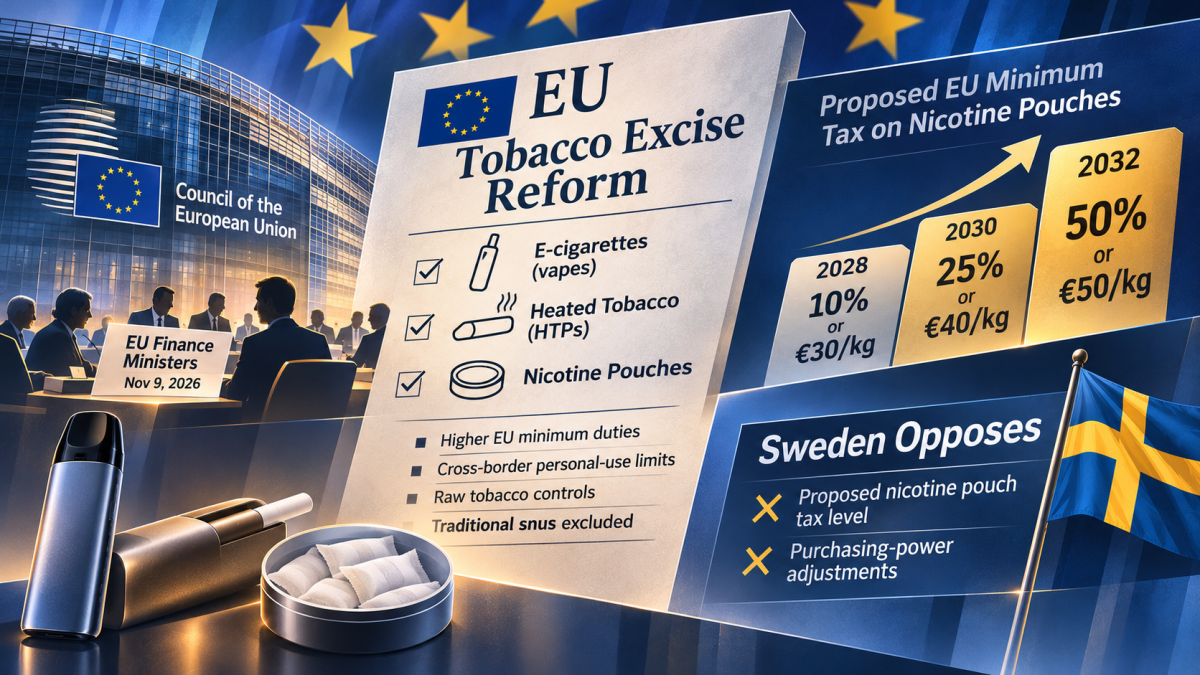
EU Vape, Heated Tobacco and Nicotine Pouch Tax Reform Reaches Ministerial Talks: Sweden Opposes Proposed 2032 Minimum of 50% of Retail Price or €50/kg for Nicotine Pouches
EU finance ministers are scheduled to discuss tobacco excise reform on November 9, 2026, seeking agreement on higher minimum duties for conventional tobacco and a common EU minimum tax framework covering e-cigarettes, heated tobacco and nicotine pouches. A November 5 Council document identifies nicotine pouch taxation as the main outstanding issue. The Irish Council presidency proposes phased increases, reaching 50% of retail selling price or €50 per kilogram in 2032. Sweden has formally said it cannot support the current compromise, objecting to both the proposed nicotine pouch tax burden and the adjustment of minimum rates based on national purchasing power. The package also addresses cross-border personal-use reference quantities, raw tobacco controls and the continued exclusion of traditional tobacco snus.
Regulations
Nov.10
U.S. Rep. Krishnamoorthi Questions FDA Over Planned PMTA Rewrite, Seeks Communications With Altria and Reynolds
U.S. Rep. Raja Krishnamoorthi on Oct. 6 questioned the FDA over its plan to reassess and potentially replace the 2021 PMTA regulatory framework, asking the agency to identify provisions it may change or eliminate, state whether current scientific evidentiary standards will be maintained, and disclose communications with Altria, Reynolds and other parties challenging the rule. Krishnamoorthi led a congressional investigation into JUUL and youth vaping in 2019 and has since remained active on e-cigarette regulation and enforcement.
Regulations
Oct.08
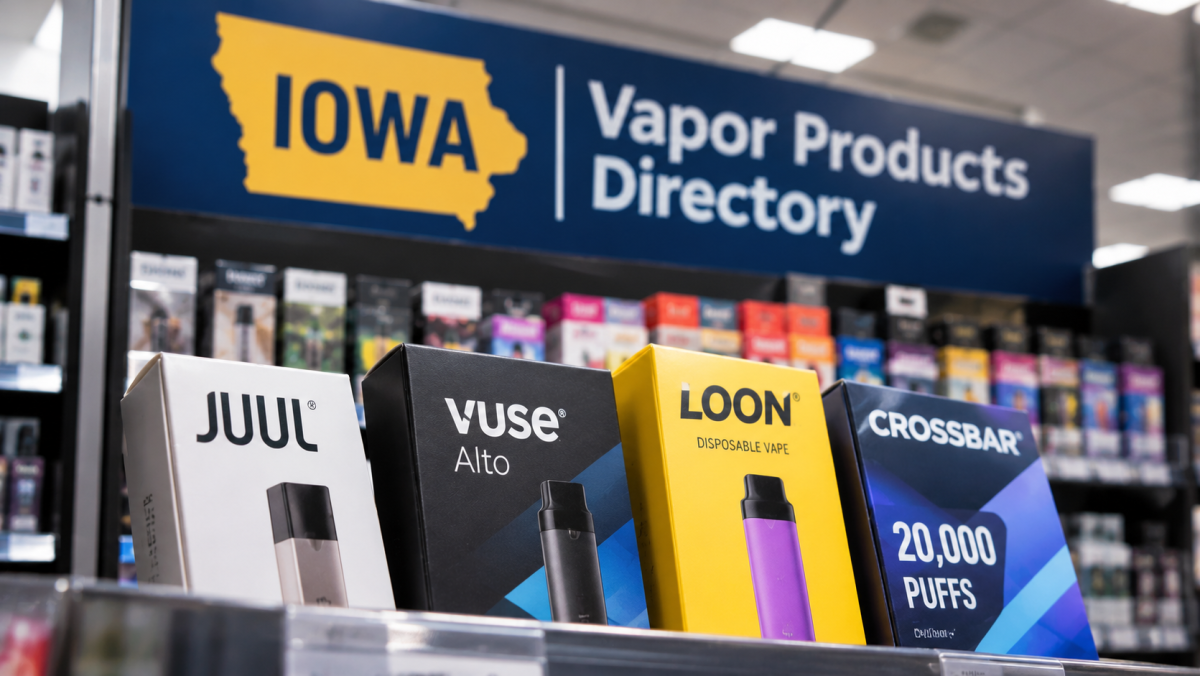
Iowa's First Vape Directory Lists JUUL and Vuse Pod Systems Alongside Loon and Crossbar Disposables, With 20,000-Puff Products Listed Across States
Iowa published its first vapor products directory on November 16, 2026, listing 361 product entries, including 175 covering prefilled pods, devices, kits and disposable e-cigarettes. Established tobacco-company brands such as JUUL and Vuse appear alongside independent disposable brands including Loon, Crossbar and Z Stick. The products range from traditional small-capacity disposables to Crossbar's 13mL, 20,000-puff devices. Of the 361 records, 288 are marked FDA Pending. Both Crossbar entries were dated November 16 and carry UPCs also found in other state directories. By contrast, a matching Z Stick product lost its active Louisiana listing after its certification was not renewed.
Regulations
Nov.17
South Korea's Tobacco Plan Excludes 6-Methyl Nicotine as Customs Tightens Import Controls and Analog Liquid Imports Fall 83%
South Korea's government unveiled its first Tobacco Harm Management Basic Plan for 2027–2031 on October 29, 2026, proposing broader testing of vaping and heated tobacco products while excluding nicotine analogs such as 6-methyl nicotine. Synthetic nicotine came under tobacco regulation on April 24, and a June investigation found 6-methyl nicotine in 12 liquid inhalation products marketed as nicotine-free. Customs data released in September showed that imports of nicotine analog solutions fell 83.3%, from 12 metric tons in January–April to 2 metric tons in May–August. By September 20, imports had reached approximately 15 metric tons for the year, with 99.99% originating from China. Customs authorities have tightened pre-clearance testing and supply-chain documentation requirements, while the MFDS expects to complete its assessment of nicotine analog hazards by the end of 2026.
Regulations
Nov.04
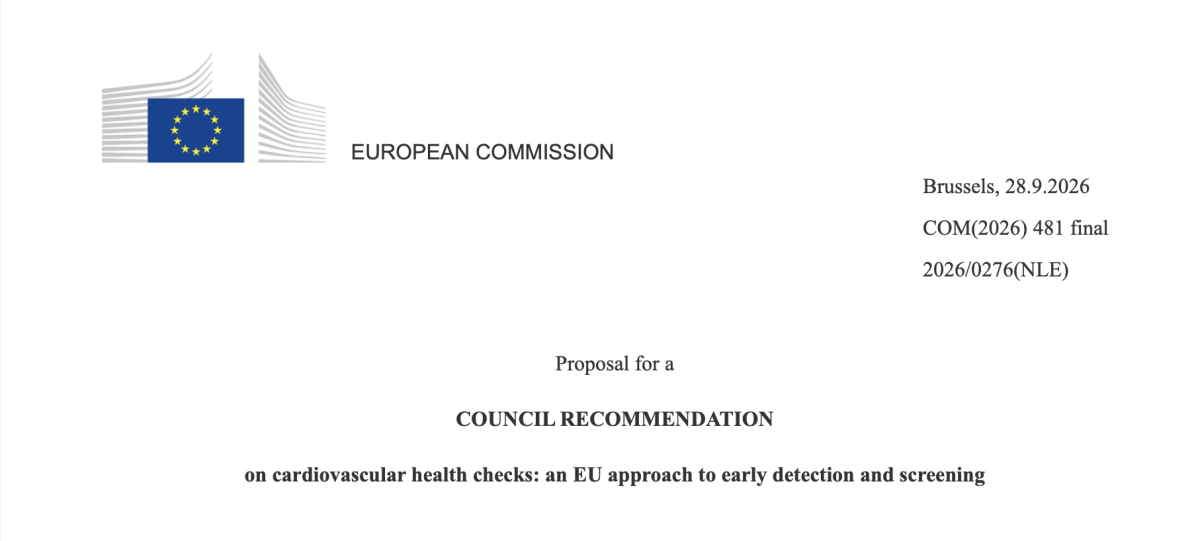
EU Commission Clarifies Vaping, Smokeless Nicotine Use in Proposed Cardiovascular Checks
The European Commission has clarified to 2Firsts that its proposed cardiovascular health checks would assess smoking, vaping and the use of smokeless nicotine products as part of patients’ medical histories. The Commission also said Member States may organise additional checks within their healthcare systems. In the same response, it pointed to JRC research on e-cigarettes, heated tobacco products and nicotine pouches that has fed into the evaluation of EU tobacco legislation.
Nov.09
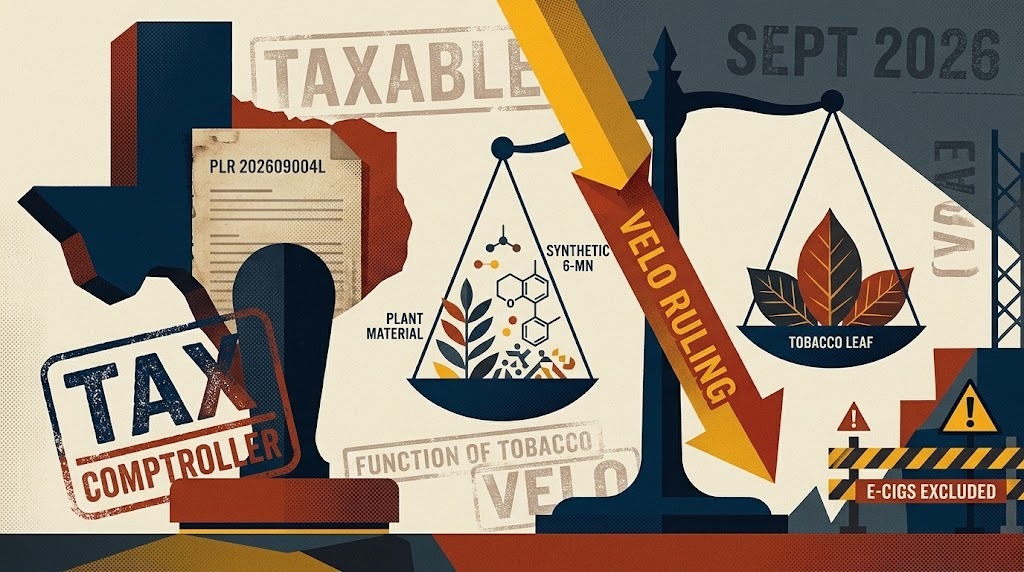
Texas Extends Tobacco Tax Interpretation to a 6-Methylnicotine Product, Citing VELO Ruling
The Texas Comptroller of Public Accounts ruled in September 2026 that a combustible product made with non-tobacco plant material and 6-methylnicotine (6-MN), a synthetic nicotine analog, qualifies as a taxable tobacco product. The applicant said the product contained neither tobacco leaf nor measurable conventional nicotine. The determination applies reasoning from a May Texas Supreme Court decision involving VELO nicotine pouches, finding that the plant material and 6-MN together perform the functions of tobacco in a conventional smoking product. The ruling carries applicable tax, licensing and reporting obligations but is limited to the facts submitted by the taxpayer. It does not establish a blanket tax classification for all 6-MN products or extend the same conclusion to e-cigarettes.
Regulations
Nov.06