Tennessee to Impose 10% Tax on E-Cigarettes Starting July; Retailers Question Enforcement Clarity

Jul.09.2025
Tennessee to Impose 10% Tax on E-Cigarettes Starting July; Retailers Question Enforcement Clarity
A new law in Tennessee aimed at curbing youth vaping took effect in July, imposing a 10% excise tax and requiring e-cigarette products to be registered with the state. However, industry insiders say enforcement has been chaotic and regulations unclear, leaving small and mid-sized retailers confused.

【2Firsts News Flash】According to NewsChannel9, a new law that went into effect this month in Tennessee imposes more restrictions and taxes on the sale of e-cigarettes and vaping products. State lawmakers say the new law is designed to reduce opportunities for youth to access e-cigarette products. However, some industry professionals in the e-cigarette sector have expressed confusion over the law.


Under the new regulations, certain e-cigarette products will be subject to a new 10% tax rate. The law also establishes a deadline of August 1st for implementing additional enforcement and tracking measures. Retailers will be required to only sell e-cigarette products that are on an approved list by the state government.


There are still questions as to when and where businesses can access this list.


The president of the Tennessee Smoke Free Association, Daniel Gillis, stated, "This law has not addressed the problem of youth vaping e-cigarettes at all, it is just disguised as a 'youth e-cigarette prevention act'.


Gillis stated that the law will be implemented in three stages: the first stage involves a 10% tax starting this month, the second stage involves product registration beginning in 2026, and the third stage involves full enforcement starting in 2027.


"They are imposing taxes on a product that they themselves do not understand."


Although shop owners have been asked to adhere to the new regulations, Gilles said that many people do not truly understand the content of the rules, and the guidance provided by the state government is also very limited.


"Many stores, especially those not affiliated with the Tennessee Smoke Free Association, are now in the dark about what exactly this bill entails."


The bill's sponsor, State Representative David Hawk, stated:


"Starting from July 1st, the Tennessee Alcoholic Beverage Commission will be responsible for overseeing e-cigarette shops to ensure compliance with the new laws. Additionally, the Tennessee Department of Revenue will ultimately be in charge of creating a register of e-cigarette products. Therefore, these two state agencies are the primary enforcement bodies."


However, Gillis pointed out that the biggest issue in law enforcement lies in the cross-border circulation of products and the fact that some suppliers still do not have licenses.


"I believe law enforcement will be a major issue, and the market competition during the period before distributors obtain sales permits will be extremely unfair. I think we should establish an e-cigarette sales permit system first, clarify who is selling, and then control distribution."


Currently, e-cigarette stores must ensure that their suppliers have obtained licenses and that the products they sell can be included in the state government's registry in the future.


Gillis stated that he will continue to work with the state government to seek clearer guidance, but also warned that this confusion and delay could harm small businesses rather than improve public health.


We welcome news tips, article submissions, interview requests, or comments on this piece.

Please contact us at info@2firsts.com, or reach out to Alan Zhao, CEO of 2Firsts, on LinkedIn


Notice

1.  This article is intended solely for professional research purposes related to industry, technology, and policy. Any references to brands or products are made purely for objective description and do not constitute any form of endorsement, recommendation, or promotion by 2Firsts.

2.  The use of nicotine-containing products — including, but not limited to, cigarettes, e-cigarettes, nicotine pouchand heated tobacco products — carries significant health risks. Users are responsible for complying with all applicable laws and regulations in their respective jurisdictions.

3.  This article is not intended to serve as the basis for any investment decisions or financial advice. 2Firsts assumes no direct or indirect liability for any inaccuracies or errors in the content.

4.  Access to this article is strictly prohibited for individuals below the legal age in their jurisdiction.


Copyright


This article is either an original work created by 2Firsts or a reproduction from third-party sources with proper attribution. All copyrights and usage rights belong to 2Firsts or the original content provider. Unauthorized reproduction, distribution, or any other form of unauthorized use by any individual or organization is strictly prohibited. Violators will be held legally accountable.

For copyright-related inquiries, please contact: info@2firsts.com


AI Assistance Disclaimer


This article may have been enhanced using AI tools to improve translation and editorial efficiency. However, due to technical limitations, inaccuracies may occur. Readers are encouraged to refer to the cited sources for the most accurate information.

We welcome any corrections or feedback. Please contact us at: info@2firsts.com

As JUUL2 Wins FDA Authorization, Harm Reduction Journal Highlights the Role of Real-World Evidence in Nicotine Product Regulation
A commentary published in the international open-access, peer-reviewed Harm Reduction Journal argues that randomized controlled trials remain central to evaluating smoking cessation efficacy but cannot alone capture real-world uptake, complete switching, longer-term use and population impact of non-combustible nicotine products such as e-cigarettes, heated tobacco and nicotine pouches. The authors frame impact as “reach × efficacy” and call for real-world evidence to complement RCTs. Three days after publication, the FDA authorized three JUUL2 products and highlighted complete switching among adult smokers in explaining its decision, providing a timely regulatory backdrop to the debate.
Sep.08
China STMA Deputy Administrator Meets KT&G COO as Heated Cigarette Rules Advance
Wang Gongcheng, deputy administrator of China’s State Tobacco Monopoly Administration, met KT&G Chief Operating Officer Lee Sang-hak in Shanghai on September 1, according to Oriental Tobacco News. The meeting comes as China seeks public comment on a draft mandatory national standard for heated cigarettes. The report did not disclose the subjects discussed or indicate whether heated tobacco products or market access were addressed.
News
Sep.02
HG Innovation, linked to IMiracle and ELFBAR, wins China patent for 6-methylnicotine salts covering vaping and oral products
HG Innovation Limited has been granted a Chinese invention patent covering 6-methylnicotine salt formulations and their use in oral and vaping products. The technology forms salts between 6-methylnicotine and alicyclic carboxylic acids, with granted claims extending to oral products, atomization substrates and electronic atomization devices. Applicant-generated tests reported differences in oxidation stability, in-vitro cytotoxicity and aerosol heavy-metal performance compared with selected benzoate or lactate controls. HG Innovation is directly linked to the broader IMiracle and ELFBAR business network.
Sep.04
Yinghe-Controlled Vape Maker SKE Ordered to Post £569,039 Security as It Pursues Crystal Bar Design Infringement Case in UK
The UK High Court has ordered Chinese vape manufacturer Shenzhen SKE Technology to provide £569,039 ($776,000) in security for costs in its design infringement proceedings against Vapepen London and other defendants over its Crystal Bar vape product. The court did not accept the defendants’ main argument that recovering costs from a China-based company would face significant enforcement obstacles, but found that SKE had not sufficiently disclosed its own financial position. The order is procedural and does not determine the underlying infringement claims.
News
Aug.21
Australia-China Operation Dismantles Tobacco Smuggling Network: 112 Containers, 60 Arrests and A$92 Million in Illicit Tobacco
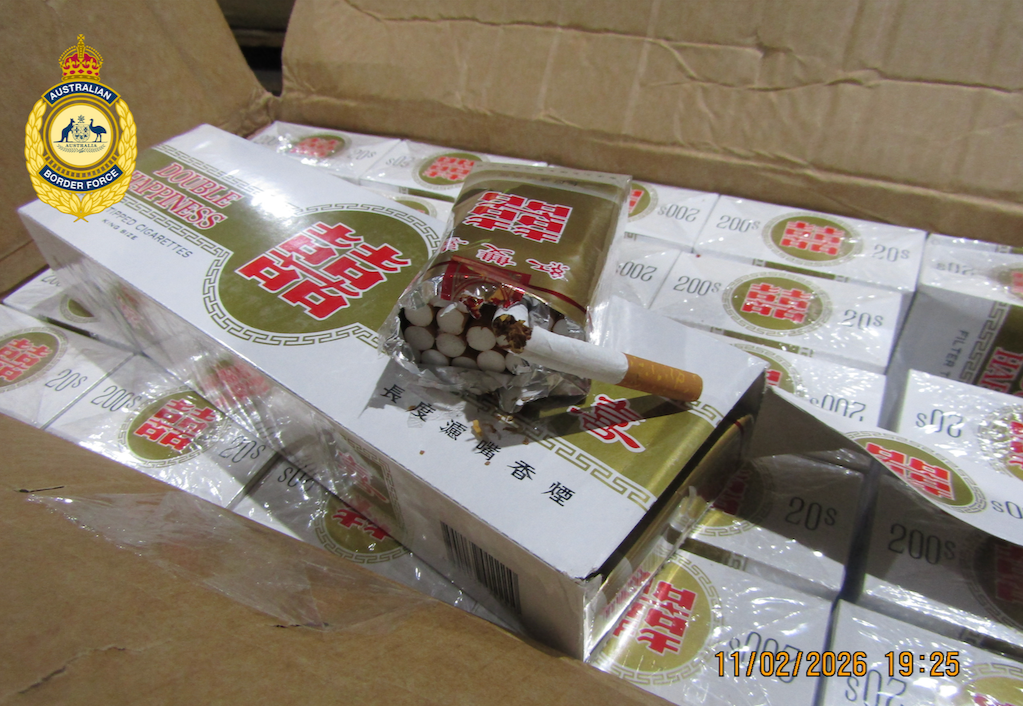
According to The Maritime Executive on August 19, 2026, the Australian Border Force (ABF) and China’s Anti-Smuggling Bureau of General Administration of China Customs worked together to dismantle an international illicit tobacco smuggling network targeting Australia. According to information released by ABF on August 20, sustained information sharing and cooperation led to investigations into 112 shipping containers, with 91 found to contain illicit tobacco. Authorities seized more than 60 million cigarettes and 60 kilograms of loose-leaf tobacco, representing more than A$92 million in unpaid duties. More than 60 people suspected of involvement in the network were arrested in China.
Aug.20
JUUL Purchasers Ask Ninth Circuit to Preserve Antitrust Classes in Case Over Altria’s $12.8 Billion Investment
Private antitrust litigation stemming from Altria's 2018 $12.8 billion investment for a 35% economic interest in JUUL is advancing before the U.S. Court of Appeals for the Ninth Circuit. Direct purchasers, indirect purchasers and indirect resellers of JUUL products filed answering briefs this week seeking to preserve class certifications granted by a California federal court in February. Altria and JUUL argue that individual consumers and large distributors differ too much in purchasing terms to remain in a single direct-purchaser class, while a separate dispute concerns whether California antitrust law can apply to indirect purchasers across 27 jurisdictions. A September trial has been put on hold during the appeal.
Sep.23