UK Disposable E-Cigarette Sales Ban: Industry Shift Towards Diversification

Mar.11.2025
UK Disposable E-Cigarette Sales Ban: Industry Shift Towards Diversification
UK to ban disposable e-cigarette sales from June 1, 2025, sparking shift to reusable devices and diverse product offerings.

Key points to watch:


1. The UK will ban the sale of disposable e-cigarettes starting June 1, 2025, a move that could prompt the industry to shift towards a more diversified product portfolio.


2. Since the beginning of 2025, the sales of disposable e-cigarettes have exceeded 18 million units, accounting for 65% of all e-cigarette sales at that time. However, with the ban taking effect on June 1st, sales of reusable devices are expected to quickly increase.


3. Nicotine pouches have exceeded £131 million in retail sales in the UK, with sales volume increasing by 82% compared to the previous year.


The UK will ban the sale and supply of disposable e-cigarettes starting June 1, 2025, Conveniencestore reported. This will apply to in-store sales, inventory holdings, and the provision of sales, all of which will be deemed illegal.


John Rennie, the head of Philip Morris International (PMI) for the UK and Ireland, suggests that diversifying product portfolios is key to staying competitive in a changing market.


"68% of independent retailers believe that success depends on offering a diverse product mix, including a full range of e-cigarettes, Heating and non-combustible products, and nicotine pouches, rather than relying on a single category like disposable products as before."


 Susanna De Iesu, commercial director for Ireland at British American Tobacco (BAT), added that despite these changes looming, there is still strong demand in the market for more traditional e-cigarette products.


"According to Nielsen data, since early 2025, the sales of disposable e-cigarettes of all brands have exceeded 18 million units, accounting for 65% of all e-cigarette sales at that time."


Angelo Yang from ELFBAR predicts that, before the ban goes into effect, these types of products will still dominate the market, but reusable devices will quickly increase in popularity.


Prianka Jhingan, the marketing director of Scandinavian Tobacco Group UK, stated that:


"Our latest data shows that nicotine pouch sales in the UK have increased by 82%, with traditional retail annual sales reaching £131 million, and this figure does not even include online sales. This reflects an 82% year-on-year growth in sales, clearly demonstrating its increasing popularity and consumer demand. ZYN's performance in the UK is particularly strong, with sales increasing by 161% year-on-year."


In addition, the ban on June 1 could be the latest legislation to disrupt the category. Currently, there are proposals to ban e-cigarette flavors and e-cigarette displays.


Angelo said:


"Research from ELFBAR indicates that if overly strict regulations are imposed on flavors, packaging, and display in addition to a ban on disposable use, approximately 2 million e-cigarette users in the UK (35%) may turn to illegal disposable e-cigarettes, resume smoking, or increase tobacco consumption."


Mark McGuinness, UK Market Director at Japan Tobacco International (JTI), added that a recent survey found that 78% of retailers expect the generational ban to result in an increase in illegal tobacco sales in local markets.


We welcome news tips, article submissions, interview requests, or comments on this piece.

Please contact us at info@2firsts.com, or reach out to Alan Zhao, CEO of 2Firsts, on LinkedIn


Notice

1.  This article is intended solely for professional research purposes related to industry, technology, and policy. Any references to brands or products are made purely for objective description and do not constitute any form of endorsement, recommendation, or promotion by 2Firsts.

2.  The use of nicotine-containing products — including, but not limited to, cigarettes, e-cigarettes, nicotine pouchand heated tobacco products — carries significant health risks. Users are responsible for complying with all applicable laws and regulations in their respective jurisdictions.

3.  This article is not intended to serve as the basis for any investment decisions or financial advice. 2Firsts assumes no direct or indirect liability for any inaccuracies or errors in the content.

4.  Access to this article is strictly prohibited for individuals below the legal age in their jurisdiction.


Copyright


This article is either an original work created by 2Firsts or a reproduction from third-party sources with proper attribution. All copyrights and usage rights belong to 2Firsts or the original content provider. Unauthorized reproduction, distribution, or any other form of unauthorized use by any individual or organization is strictly prohibited. Violators will be held legally accountable.

For copyright-related inquiries, please contact: info@2firsts.com


AI Assistance Disclaimer


This article may have been enhanced using AI tools to improve translation and editorial efficiency. However, due to technical limitations, inaccuracies may occur. Readers are encouraged to refer to the cited sources for the most accurate information.

We welcome any corrections or feedback. Please contact us at: info@2firsts.com

Reynolds Seeks to Join Altria Lawsuit Challenging FDA PMTA Rule and Calculation of 180-Day Deadline
Three R.J. Reynolds companies are seeking to intervene in a lawsuit filed by Altria subsidiaries Helix Innovations and NJOY challenging the FDA's 2021 PMTA final rule. The companies dispute how the agency uses Acceptance and Filing reviews and completeness determinations to establish when the Tobacco Control Act's 180-day decision period begins. Reynolds has also linked prolonged PMTA reviews to competition from unauthorized vaping products. The FDA, meanwhile, has been accelerating reviews and reducing its backlog.
Sep.14
PMI Global R&D Chief Meets Chinese Tobacco Regulator as China Advances Heated Cigarette Standards
Philip Morris International’s global R&D chief Michele Cattoni met Liu Sanjiang, deputy director of China’s State Tobacco Monopoly Administration, in Beijing on Aug. 27. The meeting comes as China advances mandatory standards for heated cigarettes and nicotine pouches, laying groundwork for their domestic introduction. Cattoni has held senior roles in PMI’s heated tobacco development, while China’s draft standard covers multiple heating architectures, including systems similar in principle to PMI’s IQOS ILUMA technology.
Aug.27
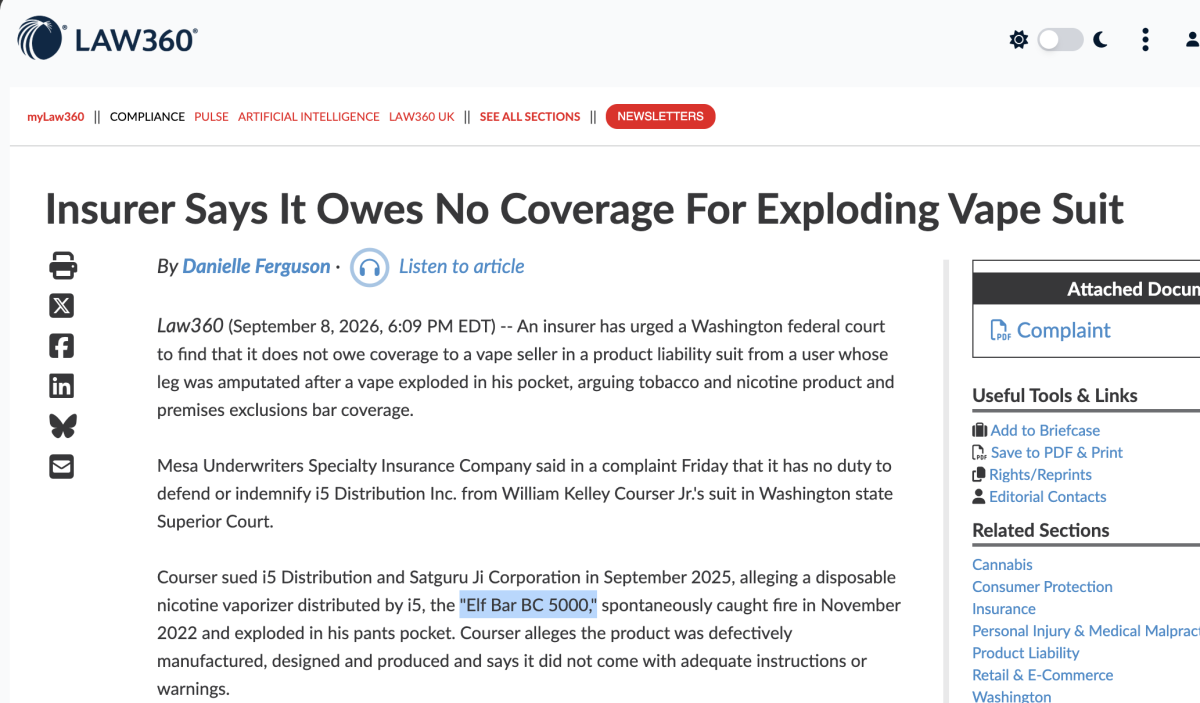
Elf Bar Vape Explosion and Amputation Claim Spurs Coverage Suit, U.S. Insurer MUSIC Seeks Ruling It Owes No Duty to Defend or Indemnify Distributor i5
Mesa Underwriters Specialty Insurance Company has asked a federal court in Washington to declare that it has no duty to defend or indemnify vape distributor i5 Distribution in a product liability case involving an Elf Bar BC5000. The plaintiff alleges that the disposable vape caught fire and exploded in his pocket, causing severe burns and ultimately requiring an above-the-knee amputation of his left leg. MUSIC is relying on a tobacco, nicotine or nicotine replacement products exclusion and a premises limitation endorsement. The court has not ruled on the coverage dispute.
News
Sep.10
Arizona Turns to a 50% Retail Vape Tax as Tobacco Tax Revenue Falls 47% From 2008
Arizona's First Things First is pushing for an excise tax equal to 50% of the retail price of vaping products, estimating that the measure could generate about $100 million annually. The agency says its tobacco-tax revenue has fallen 47% from 2008 levels. Arizona has attempted to broaden its nicotine tax base in each of the past two years: a 2025 bill proposed a 50% wholesale-price tax, while a 2026 measure shifted to a 50% retail-price tax covering alternative nicotine products and vapor products. Separately, the state enacted HB 4001 this year to establish a new licensing and sales framework for alternative nicotine products.
Sep.21
CCPIT Says Trade Friction Index for China-Related Electronics Sector Remains High, With Vape Products Among Areas of Focus
China Council for the Promotion of International Trade (CCPIT) held its July regular press conference on July 31, 2026, releasing the May 2026 Global Economic and Trade Friction Index. CCPIT spokesperson Yang Fan said the global trade friction index stood at 95 in May, remaining at a medium-to-high level. By industry, the electronics sector recorded the highest trade friction index among 13 monitored industries. In China-related trade frictions, the index stood at 93, with electronics products including drones, chips and vape products among areas where friction remained elevated.
Aug.03
Russia Adds Vapes to “Strategic Goods” List, Illegal Cross-Border Trade Faces Up to Five Years in Prison
Russia will place e-cigarettes and related nicotine products under its “strategic goods” framework from August 20, 2026. According to TVP World’s report published on August 19, the newly listed items include e-cigarettes, electronic smoking devices, vape liquids and nicotine salts. Individuals who illegally move these products across Russia’s customs border or its state border with other Eurasian Economic Union (EAEU) members could face up to five years in prison if shipment values exceed 100,000 rubles (about €1,000), provided all elements of a criminal offence are established.
Aug.20