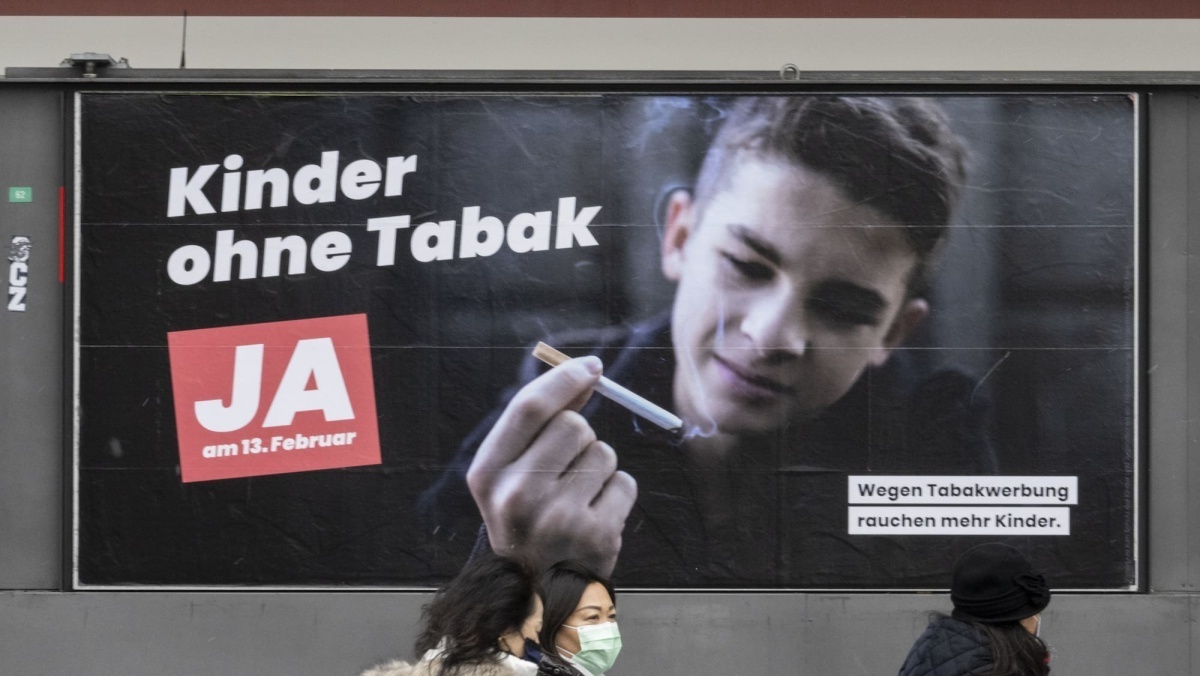
According to Blick on December 16th, on Monday (the 16th), the Swiss National Council made a decision again on the implementation of a ban on tobacco advertising.
Three years ago, Swiss voters approved a ban on tobacco advertising in all places visible to children and adolescents. However, implementing this decision in parliament has proven to be difficult. Earlier this year, the National Council rejected the Federal Council's initial proposal, which did not go as far as advocates and former Health Minister Alain Berset had requested, in implementing comprehensive restrictions on advertising and sponsorship.
The federal government continues to adhere to several exceptions, such as allowing mobile salespeople to advertise, placing tobacco ads in public places, and sponsoring events as long as it is not visible to minors. The Federal Health Office also pointed out that there is little leeway in the strict written constitution. A report last year mentioned that these amendments are considered illegal by the executive branch, and the Cancer Alliance criticized the federal government for not respecting public opinion.
Conservatives believe that the proposal excessively restricts free market operations. The Swiss People's Party stated in a previous national committee discussion that the proposal overly suppresses the market and is being supported by left-wing parties in an attempt to sabotage it.
Philip Morris International (PMI), British American Tobacco, and Japan Tobacco International all have production facilities in Switzerland, exerting significant political influence. Switzerland also has a "debt" to repay from twenty years ago: the Framework Convention on Tobacco Control, signed in 2004, requires various measures to reduce the attractiveness of smoking, including a ban on tobacco advertising. However, Switzerland has not fully fulfilled this commitment to date, making it one of four European countries that have not implemented the agreement.
The federal government implemented a new tobacco control law in October of this year, prohibiting the sale of tobacco products to minors and banning tobacco advertisements in public and private spaces visible from public areas. However, health alliances and prevention organizations believe that this measure is still insufficient, and if a lighter advertising ban is ultimately put in place by Parliament, they will take action against it.
As a last resort, advocates such as former Social Democratic Party federal Senator and "Smoke-Free Children" President Hans Stöckli, 72, have stated that they may have to initiate a public referendum.
We welcome news tips, article submissions, interview requests, or comments on this piece.
Please contact us at info@2firsts.com, or reach out to Alan Zhao, CEO of 2Firsts, on LinkedIn
Notice
1. This article is intended solely for professional research purposes related to industry, technology, and policy. Any references to brands or products are made purely for objective description and do not constitute any form of endorsement, recommendation, or promotion by 2Firsts.
2. The use of nicotine-containing products — including, but not limited to, cigarettes, e-cigarettes, nicotine pouchand heated tobacco products — carries significant health risks. Users are responsible for complying with all applicable laws and regulations in their respective jurisdictions.
3. This article is not intended to serve as the basis for any investment decisions or financial advice. 2Firsts assumes no direct or indirect liability for any inaccuracies or errors in the content.
4. Access to this article is strictly prohibited for individuals below the legal age in their jurisdiction.
Copyright
This article is either an original work created by 2Firsts or a reproduction from third-party sources with proper attribution. All copyrights and usage rights belong to 2Firsts or the original content provider. Unauthorized reproduction, distribution, or any other form of unauthorized use by any individual or organization is strictly prohibited. Violators will be held legally accountable.
For copyright-related inquiries, please contact: info@2firsts.com
AI Assistance Disclaimer
This article may have been enhanced using AI tools to improve translation and editorial efficiency. However, due to technical limitations, inaccuracies may occur. Readers are encouraged to refer to the cited sources for the most accurate information.
We welcome any corrections or feedback. Please contact us at: info@2firsts.com