Challenging Future of Tobacco Companies in the Post-Cigarette Era

Market by 2FIRSTS.ai
Feb.02.2024
Challenging Future of Tobacco Companies in the Post-Cigarette Era
Tobacco companies face limitations as the UK bans disposable e-cigarettes, impacting the growing market dominated by Chinese imports.

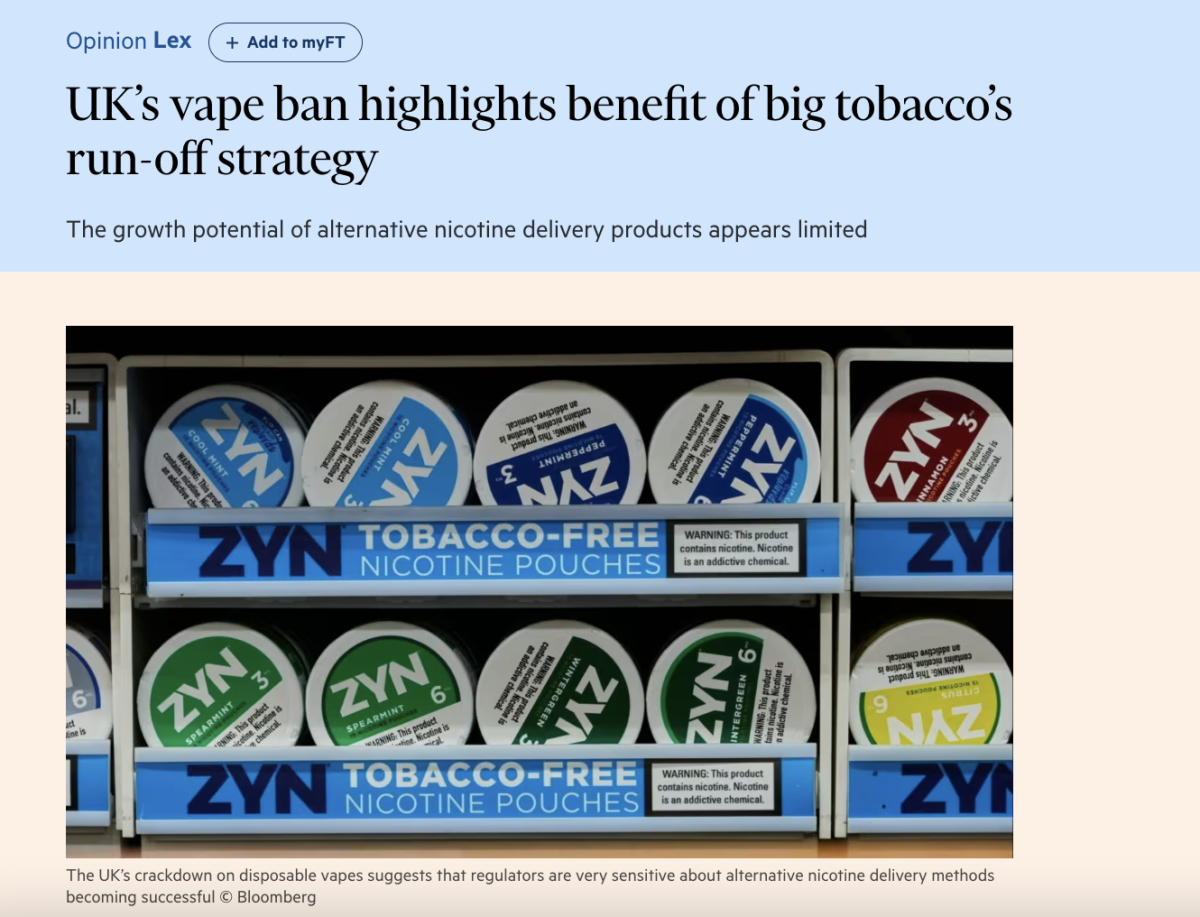
Those who have attempted self-help programs know that change is not easy, and this struggle applies to tobacco companies as well. They hope to capitalize on the remnants of their traditional cigarette business to drive sales of e-cigarettes and oral smokeless tobacco (snuff), and strive to create a sustainable future. However, as demonstrated by the ban on disposable e-cigarettes in the UK, the growth potential of alternative nicotine delivery products seems to be limited.
Challenging Future of Tobacco Companies in the Post-Cigarette Era


It should be noted that the new policy in the UK is not directly targeting traditional tobacco manufacturers such as British American Tobacco and Imperial Brands. Its focus is on the disposable e-cigarette market, which is valued at £1.3 billion and predominantly dominated by Chinese imports known for their diverse flavors such as colorful and bubblegum. According to data from Action on Smoking and Health (ASH), this market is growing rapidly and is expected to account for 31% of the entire e-cigarette market by 2023, compared to just 2% in 2021.
Challenging Future of Tobacco Companies in the Post-Cigarette Era


Tobacco companies focusing on non-disposable e-cigarettes may see the ban as having a positive impact on their smokeless business. Despite a decrease in sales of devices with fewer colors, their market position is expected to remain unchanged. These companies may also hope to shift the demand towards other smokeless products, such as "modern oral," a new form of snuff. Similar to the Renaissance, Philip Morris acquired Swedish Match and its Zyn nicotine pouch products in 2022, with sales in this category predicted to double in the United States by 2030.


However, this hopeful prospect overlooks a key issue. The actions taken by the UK indicate that regulatory authorities are highly sensitive to the rise of alternative nicotine delivery methods, especially if they begin to attract "never smokers." Therefore, pursuing growth in these categories is a complex balancing act.


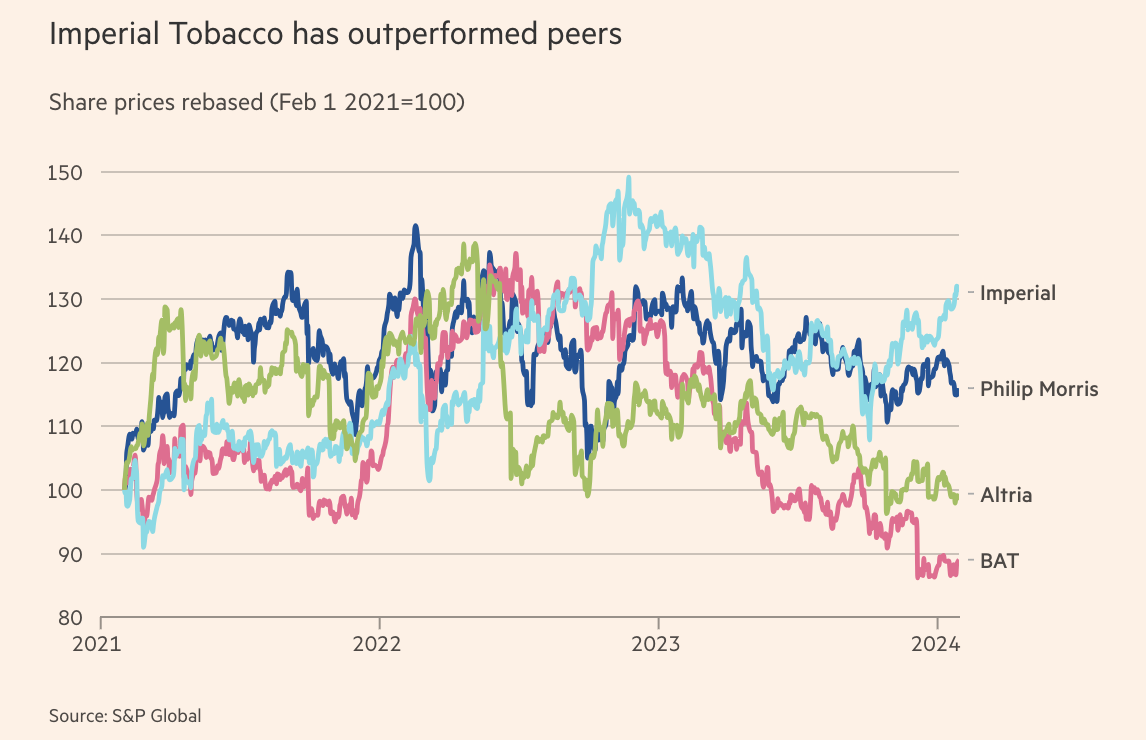
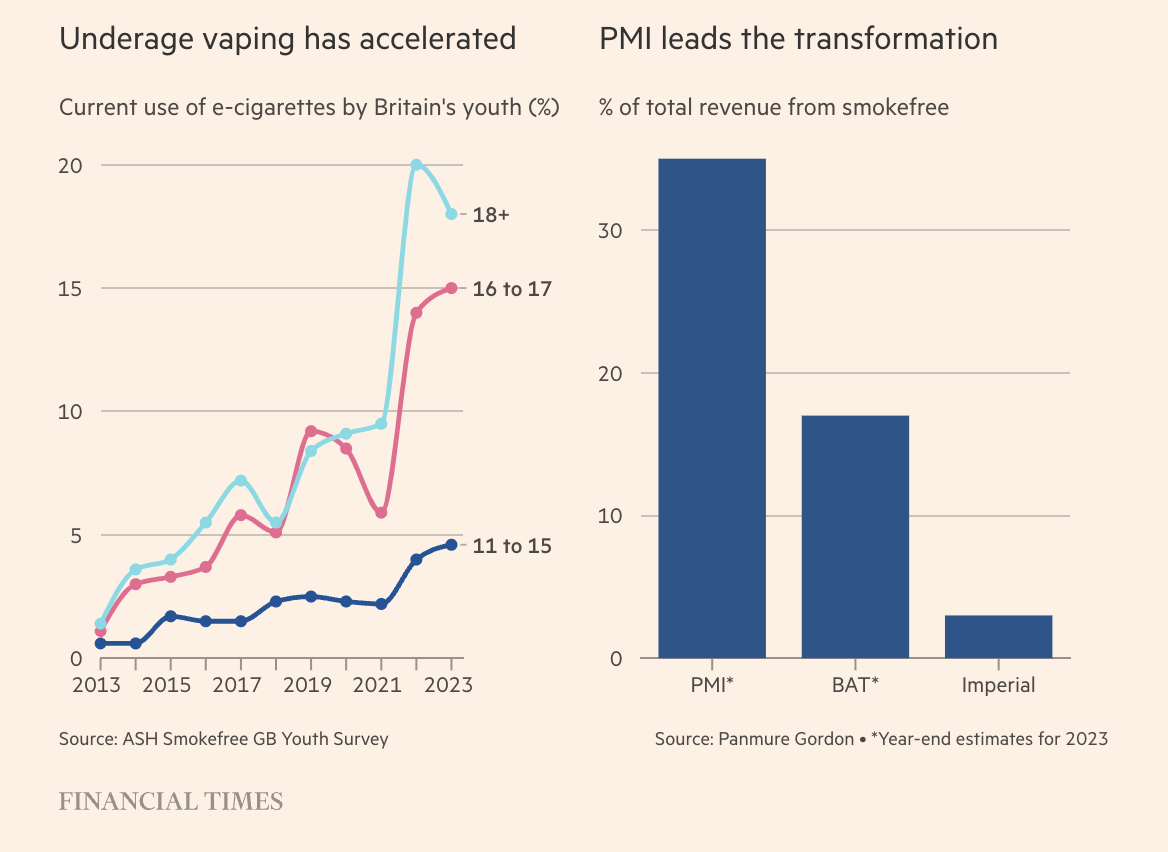
Investors may not necessarily pay a long-term price for this outlook. According to Panmure Gordon, Philip Morris leads the way in the smokeless sector, with 35% of its revenue coming from this area. Despite its forward price-to-earnings ratio of 15 times, double the valuation multiple of its British counterparts, its stock price has consistently lagged behind Imperial Brands over the past three years, with little to no alternative products. Instead, Philip Morris is more inclined to return cash to its shareholders.


Taking the UK as an example, if all regulatory bodies agree that there is no favorable way of smoking, then Imperial Tobacco Company's strategy may be the most suitable for this declining industry.


We welcome news tips, article submissions, interview requests, or comments on this piece.

Please contact us at info@2firsts.com, or reach out to Alan Zhao, CEO of 2Firsts, on LinkedIn


Notice

1.  This article is intended solely for professional research purposes related to industry, technology, and policy. Any references to brands or products are made purely for objective description and do not constitute any form of endorsement, recommendation, or promotion by 2Firsts.

2.  The use of nicotine-containing products — including, but not limited to, cigarettes, e-cigarettes, nicotine pouchand heated tobacco products — carries significant health risks. Users are responsible for complying with all applicable laws and regulations in their respective jurisdictions.

3.  This article is not intended to serve as the basis for any investment decisions or financial advice. 2Firsts assumes no direct or indirect liability for any inaccuracies or errors in the content.

4.  Access to this article is strictly prohibited for individuals below the legal age in their jurisdiction.


Copyright


This article is either an original work created by 2Firsts or a reproduction from third-party sources with proper attribution. All copyrights and usage rights belong to 2Firsts or the original content provider. Unauthorized reproduction, distribution, or any other form of unauthorized use by any individual or organization is strictly prohibited. Violators will be held legally accountable.

For copyright-related inquiries, please contact: info@2firsts.com


AI Assistance Disclaimer


This article may have been enhanced using AI tools to improve translation and editorial efficiency. However, due to technical limitations, inaccuracies may occur. Readers are encouraged to refer to the cited sources for the most accurate information.

We welcome any corrections or feedback. Please contact us at: info@2firsts.com

South Korea Imports 12,126 Kg of Nicotine Analogues From April to August After Bringing Synthetic Nicotine Under Tobacco Law
South Korea's liquid-vape market is showing changes across raw-material imports, product types and sales channels after synthetic nicotine came under the Tobacco Business Act on April 24. Customs data show nicotine-analogue imports totaled 12,126 kilograms from April through August, while synthetic-nicotine imports over the same five months totaled 231,663 kilograms, just 39.3% of the amount imported in March alone. Physical liquid-vape stores tracked in Seoul and Gyeonggi Province fell 9.9%, unmanned outlets edged higher and online sales listings increased from 27,774 to 42,437. Government testing of 105 liquid inhalation products promoted as nicotine-free separately found nicotine in 13 and 6-methylnicotine in 12.
Sep.22
Imperial Brands Acquires Helwit Owner Yoik Group for SEK 515 Million, More Than Doubling Swedish Nicotine Pouch Share
Imperial Brands has agreed to acquire 100% of Swedish modern oral nicotine company Yoik Group AB for an initial SEK515 million, equivalent to about US$53.9 million, plus a deferred payment linked to performance over the next two years. Yoik owns nicotine pouch brand Helwit, which held about 3.4% of Sweden’s modern oral nicotine market over the past 12 months. Imperial says the acquisition will more than double its existing share of the Swedish market. Helwit is also sold elsewhere in the Nordics, through European online channels and in selected UK retail outlets.
Sep.08
Arizona Turns to a 50% Retail Vape Tax as Tobacco Tax Revenue Falls 47% From 2008
Arizona's First Things First is pushing for an excise tax equal to 50% of the retail price of vaping products, estimating that the measure could generate about $100 million annually. The agency says its tobacco-tax revenue has fallen 47% from 2008 levels. Arizona has attempted to broaden its nicotine tax base in each of the past two years: a 2025 bill proposed a 50% wholesale-price tax, while a 2026 measure shifted to a 50% retail-price tax covering alternative nicotine products and vapor products. Separately, the state enacted HB 4001 this year to establish a new licensing and sales framework for alternative nicotine products.
Sep.21
Retail Case Study | Wisconsin Vape Market One Year After New Regulations: Johnny Vapes Reports 80% Sales Decline as Consumers Shift Online and Across State Lines
According to WNCY on August 24, 2026, some independent vape retailers in Wisconsin say they have faced significant business pressure one year after new vape regulations took effect. Johnny Vapes, a retailer operating in northeast Wisconsin, said its store count fell from seven locations to four, sales declined by about 80%, and roughly 90% of its inventory was affected. Retailers said some consumers have shifted to online purchases or traveled to neighboring Michigan to buy vape products. The case highlights how local regulations can reshape retail operations, inventory management and consumer purchasing patterns.
Aug.28
Charlie’s Says 30 PACHA Vape SKUs Tentatively Identified for FDA’s Non-Priority Enforcement Public List
Charlie’s Holdings said the U.S. Food and Drug Administration notified the company on June 23, 2026, that 30 PACHA vape SKUs with submitted PMTAs had been tentatively identified for inclusion on a planned public-facing FDA webpage. Under enforcement guidance issued by FDA in May, the webpage is intended to identify certain unauthorized products for which the agency generally does not intend to prioritize enforcement of premarket authorization requirements. Charlie’s disclosed the development alongside second-quarter revenue of $3.8 million, up 116% year over year.
Aug.25
PMI Expands U.S. ZYN Portfolio With New 1.5 mg and 8 mg Strengths, Moves Toward a Unified 20-Pouch-Per-Can Format
Philip Morris International is expanding its U.S. ZYN nicotine pouch portfolio with new 1.5 mg and 8 mg strengths and plans to move its core 3 mg and 6 mg dry-pouch products from 15 to 20 pouches per can in the fourth quarter of 2026. ZYN ULTRA is also commercially available, with FDA authorization covering 10 products at 9 mg and one 11 mg Smooth product. PMI U.S. lists the new 1.5 mg and 8 mg strengths as commercially available, but as of September 10 they do not appear on the FDA’s public authorization list. Public materials do not identify which PMTA submissions cover the two new strengths or their current review status.
Sep.11