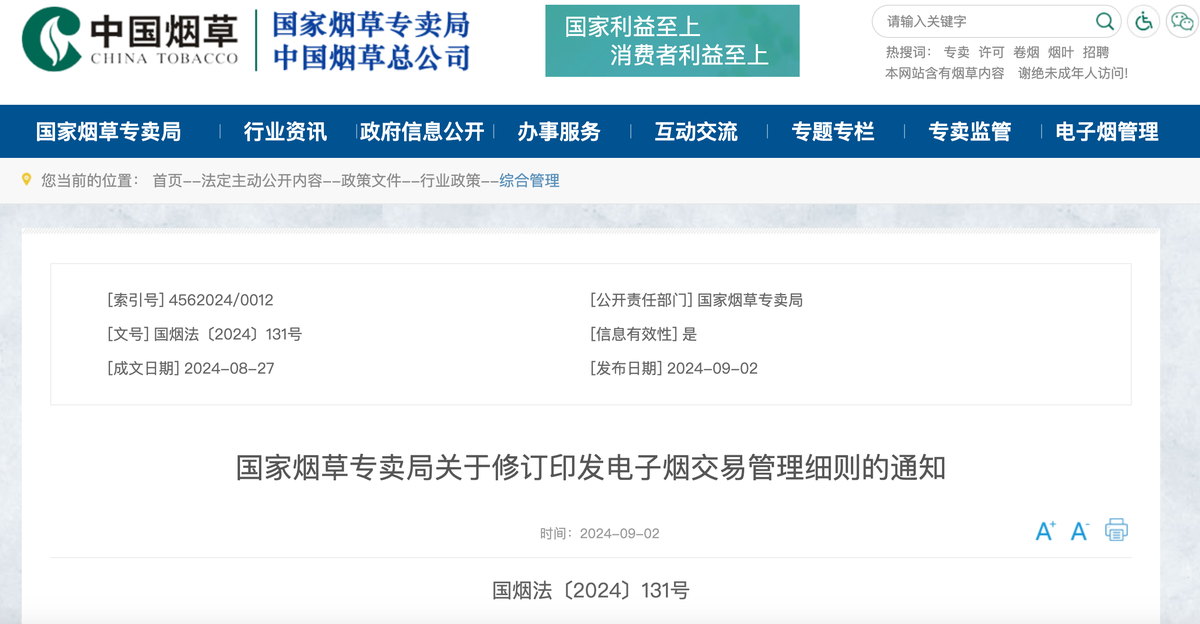
On September 2nd, the State Tobacco Monopoly Administration issued a notice on revising and issuing regulations for the management of e-cigarette transactions.
The specific announcement is as follows:
Interpretation of the policy of the "Regulations on the Management of E-cigarette Transactions"
In order to further implement the "Regulations on the Administration of E-Cigarettes" (State Tobacco Monopoly Administration Announcement No. 1 of 2022), and to strengthen the management of e-cigarette transactions, regulate the production and circulation of e-cigarettes, and protect the legitimate rights and interests of participants in the e-cigarette market, the State Tobacco Monopoly Administration has revised and issued the "Detailed Rules for the Management of E-Cigarette Transactions".
The revised "Regulations on the Management of E-cigarette Transactions" consist of six chapters and thirty articles. The main revisions include: standardizing the names of relevant trading entities and consolidating explanatory content in the appendix, reorganizing descriptions of transaction types, improving the specific content of total management, adding and simplifying some management requirements, and removing purely technical content unrelated to transaction management.
Notice on revising and issuing the regulations for the management of e-cigarette transactions by the State Tobacco Monopoly Administration.
State Tobacco Law [2024] No. 131
Provincial Tobacco Monopoly Bureau:
In order to thoroughly implement the "Regulations on the Management of E-Cigarettes" (Announcement No. 1 of 2022 by the State Tobacco Monopoly Administration), further strengthen the management of e-cigarette transactions, regulate the production and distribution order of e-cigarettes, and protect the legitimate rights and interests of e-cigarette market entities, the revised "Regulations on the Management of E-Cigarette Transactions" are now issued to you for strict implementation.
The State Tobacco Monopoly Administration
August 27, 2024
Regulations on the management of e-cigarette transactions
Chapter One: General Principles
In order to strengthen the regulation of e-cigarette transactions, standardize the production and distribution order of e-cigarettes, and protect the legitimate rights and interests of market entities of e-cigarettes, this detailed rules are formulated in accordance with the "Civil Code of the People's Republic of China", the "Electronic Commerce Law of the People's Republic of China", the "Tobacco Monopoly Law of the People's Republic of China", the "Implementing Regulations of the Tobacco Monopoly Law of the People's Republic of China", and the "Management Measures for e-cigarettes" (Announcement No. 1 of 2022 of the State Tobacco Monopoly Administration) and other relevant laws, regulations, rules, and normative documents.
Article 2: These regulations apply to the trading of e-cigarette products and e-cigarette materials within the territory of the People's Republic of China (referred to collectively as e-cigarette transactions).
The State Tobacco Monopoly Administration of the State Council is responsible for supervising and managing the national e-cigarette market.
The tobacco monopoly administration authorities at the provincial, municipal, and county levels are responsible for supervising and managing the e-cigarette trading activities of e-cigarette market entities in their respective administrative regions.
The fourth principle of e-cigarette transactions follows the principles of equality, fairness, honesty, and standardization. It promotes the full-process management of e-cigarette traders in terms of flow of goods, logistics, funds, and information flow. Transaction data is seen as an important basis for market regulation, status evaluation, and effective supervision.
Could you please rephrase the text in standard journalistic English?
Chapter Two: Types of Transactions
The fifth article states that the State Council's administrative department responsible for tobacco monopoly shall establish a national unified e-cigarette trading management platform (hereinafter referred to as the platform).
All types of e-cigarette market entities that legally obtain tobacco monopoly licenses for the sale of nicotine raw materials for e-cigarettes, nicotine production companies for e-cigarettes, aerosol production companies, e-cigarette production companies (including product production, contract manufacturing, brand-holding companies, etc.), e-cigarette wholesale companies (including e-cigarette import businesses), and e-cigarette retail operators must conduct transactions through platforms.
E-cigarettes, atomizers, and nicotine for e-cigarettes imported and exported should be registered through the platform according to regulations.
The sixth article states that e-cigarette transactions are divided into:
The transaction of e-cigarette nicotine raw materials between e-cigarette nicotine production companies and e-cigarette nicotine raw material sales companies.
The transaction of nicotine for e-cigarettes between aerosol production companies and e-cigarette nicotine production companies.
The trade of aerosols between e-cigarette manufacturers and aerosol production companies.
The e-cigarette product manufacturing company, e-cigarette brand holding company, and e-cigarette product production company, as well as the e-cigarette processing company, engage in e-cigarette product outsourcing transactions.
Wholesale e-cigarette companies engage in domestic sales transactions of e-cigarette products with e-cigarette manufacturers and e-cigarette brand holding companies.
(6) The import of nicotine for e-cigarettes between aerosol production companies and e-cigarette import businesses, and the import of aerosols between e-cigarette production companies and e-cigarette import businesses.
The trading of e-cigarette products between retail e-cigarette businesses and wholesale e-cigarette companies (including e-cigarette import businesses).
The administrative authority of the State Council for tobacco monopoly has confirmed other transactions in accordance with the "Administrative Measures for E-Cigarettes".
As heated tobacco, e-cigarettes, and nicotine pouches gain popularity, companies such as Philip Morris International and British American Tobacco are shifting their focus from simple cigarettes to high-tech, rechargeable devices.
We welcome news tips, article submissions, interview requests, or comments on this piece.
Please contact us at info@2firsts.com, or reach out to Alan Zhao, CEO of 2Firsts, on LinkedIn
Notice
1. This article is intended solely for professional research purposes related to industry, technology, and policy. Any references to brands or products are made purely for objective description and do not constitute any form of endorsement, recommendation, or promotion by 2Firsts.
2. The use of nicotine-containing products — including, but not limited to, cigarettes, e-cigarettes, nicotine pouchand heated tobacco products — carries significant health risks. Users are responsible for complying with all applicable laws and regulations in their respective jurisdictions.
3. This article is not intended to serve as the basis for any investment decisions or financial advice. 2Firsts assumes no direct or indirect liability for any inaccuracies or errors in the content.
4. Access to this article is strictly prohibited for individuals below the legal age in their jurisdiction.
Copyright
This article is either an original work created by 2Firsts or a reproduction from third-party sources with proper attribution. All copyrights and usage rights belong to 2Firsts or the original content provider. Unauthorized reproduction, distribution, or any other form of unauthorized use by any individual or organization is strictly prohibited. Violators will be held legally accountable.
For copyright-related inquiries, please contact: info@2firsts.com
AI Assistance Disclaimer
This article may have been enhanced using AI tools to improve translation and editorial efficiency. However, due to technical limitations, inaccuracies may occur. Readers are encouraged to refer to the cited sources for the most accurate information.
We welcome any corrections or feedback. Please contact us at: info@2firsts.com